|
||||||||||||||||||||||||||||||||||||||||||
|
||||||||||||||||||||||||||||||||||||||||||







| Phantom
ir300 Go to Phantom High Speed Cameras Go to Standard Resolution Monochrome Cameras Go to High Speed Cameras |
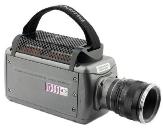 |
Previously not possible with CMOS-based, digital high-speed cameras, the combination of Vision Research's Phantom v7.3 electronics and a CMOS sensor allows the new Phantom ir300 camera to capture image events in the near IR spectrum in light that is invisible to humans.
While most CMOS sensors rapidly start losing sensitivity above 600nm, the Phantom ir300 extends that point to 800nm providing a usable range to about 1100nm.
Behaving just like the Phantom v7.3, the Phantom ir300 has the added
advantage that at wavelengths up to 600nm, it can also be used
as a general-purpose monochrome, digital high-speed camera.
Special features
The Phantom ir300 is packed with a large number of special features among
which are:
** Segment memory for up
to 16 cines in multi-cine mode
** Continuous recording
** Frame rate profile
** Memory gate
** Event marking
** Frame timestamp
** IRIG in/out (modulated
and unmodulated)
Applications for the Phantom ir300
When used with LED lights or lasers in the 850nm wavelength, the Phantom
ir300 is ideal for nocturnal animal studies and human eye studies.
Other deployments include security applications, pulsed
laser targeting applications, PIV, combustion and other uses where light
sources in the 600nm to 1100nm wavelength are used.
The camera can also be used for self-illuminating applications to see
what is happening in wavelengths the human eye can't see.
| Model | Phantom ir300 |
| Resolution | 800 x 600 full-frame |
| Frame rate | 6688 frames-per-second at full resolution; 190 000 fps at reduced resolution (32 x 32) |
| Sensor | CMOS extended-response monochrome | Video Output | NTCS, PAL, HD-SDI |
| Memory | 8 GB or 16 GB high-speed memory |
| Mount Type | Nikon f-mount standard, PL, C-, and Canon EOS available |
| Operating Temp | Active cooling with dual internal micro-fans; Operating temperature 0°C - 50°C |
 Vision Research Phantom ir300 Camera Datasheet
|
If you like this page, please recommend and share it. |
||
| More | ||


