|
||||||||||||||||||||||||||||||||||||||||||
|
||||||||||||||||||||||||||||||||||||||||||







| Phantom
Miro 320S/321S Go to Phantom High Speed Cameras Go to Ultra-High Resolution Monochrome Cameras Go to Ultra-High Resolution Colour Cameras Go to High Speed Cameras |
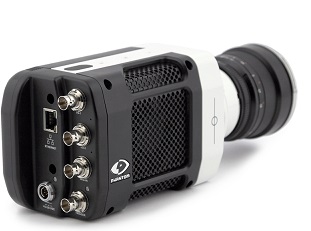 |
he Miro 320S performance level is available in two body
styles: the all-metal R-Series (R321S) is a general purpose
camera targeted at a wide variety of applications that demand a shock-tolerant,
ruggedized camera design. The R321S has a recently-added door to protect
the CineFlash card slot and an internal mechanical shutter a standard
option.
The LC-Series has a flip-out LCD touchscreen interface
for camera control and cine playback. This series has an integrated flip-out
touchscreen for on-camera control and viewing of recorded cines and best
used in a variety of applications especially those that require portability.
There are several common setups pre-installed on the LC-Series which can
be selected with a tap on the screen.
Each Miro is compatible with removable, non-volatile CineFlash storage (120GB or 240GB). CineFlash is a removable, non-volatile storage device that slides into the camera body and provides a way to quickly save shots from the camera's memory without the need for time-consuming and costly downloads. The CineFlash module is later removed from the camera and inserted into the docking station which is connected to a computer making the stored cines immediately available there. A 120GB CineFlash and Dock are bundled with both series.
The R and LC Series come with a battery that can power the camera when AC power is not available or is lost during an experiment.
Each Miro camera supports four lens mounts: Nikon F/G, C, PL or EF (EF
mounts allow the use of Canon EF and EF-S automated lenses). Adjust lens
aperture and focus remotely using the Remote Control Unit or Phantom Camera
Control software.
The cameras have a number of advanced features including global electronic
shutter, an internal capping shutter, Image-Based Auto-Trigger, camera
synchronization, immediate playback of recorded cines and are available
in colour and monochrome.
Scientists and engineers can take advantage of the 3.2 Gpx/s throughput, precise timing, camera synchronization, flexible triggering, excellent light sensitivity, and a global shutter and the camera is suitable for applications ranging from animal studies to PIV to product characterization.
In addition, artists now have access to a camera based on the Academy Award winning technology of the Phantom Flex for TV and new media applications.
Miro 320/321S
- R and LC performance levels
The Phantom Miro LAB 320S is a 2 megapixel camera with 3.2 Gigapixels/second
throughput providing 1380 fps at 1920 x 1200. The minimum digital exposure
is 1µs. The Miro 320S uses microlenses on the CMOS sensor with 10µm
pixel pitch to achieve high light sensitivity. With 12-bit pixel depth,
it also provides high dynamic range for excellent image quality.
| Model | Phantom Miro 320S/321S LC and R styles |
| Resolution | 1920 x 1200 |
| Sensor | 1 Mpx CMOS 19.2 mm x 12.0 mm. 10 µm pixel size |
| Max. Frame Rate | 1380 fps |
| Throughput | 3.2 Gpx/s |
| Memory | 6GB, 12GB high-speed internal RAM.
CineFlash bundled |
| Video Out | HD-SDI from BNC on rear of camera. Standard 720P, 1080i and 1080psf signals are supported. |
| Connectivity |
Gb Ethernet for control and data. |
| Mount Types | Canon EOS, Nikon F-mount, Nikon F mount adapter, 1" C-mount, PL-mount |
| Power Requirements | 12 - 28 VDC, 65 W |
| Temperature |
0°C to +40°C @ 8% to 80% RH. |
| Weight | 1.4 kg |
| Dimensions | 19 x 8.8 x 10 cm |

|
If you like this page, please recommend and share it. |
||
| More | ||


